New stock Arrived | FREE shipping on orders $199+

Gearless Ratchets vs Geared Ratchets: Why Fewer Moving Parts Means Longer Life
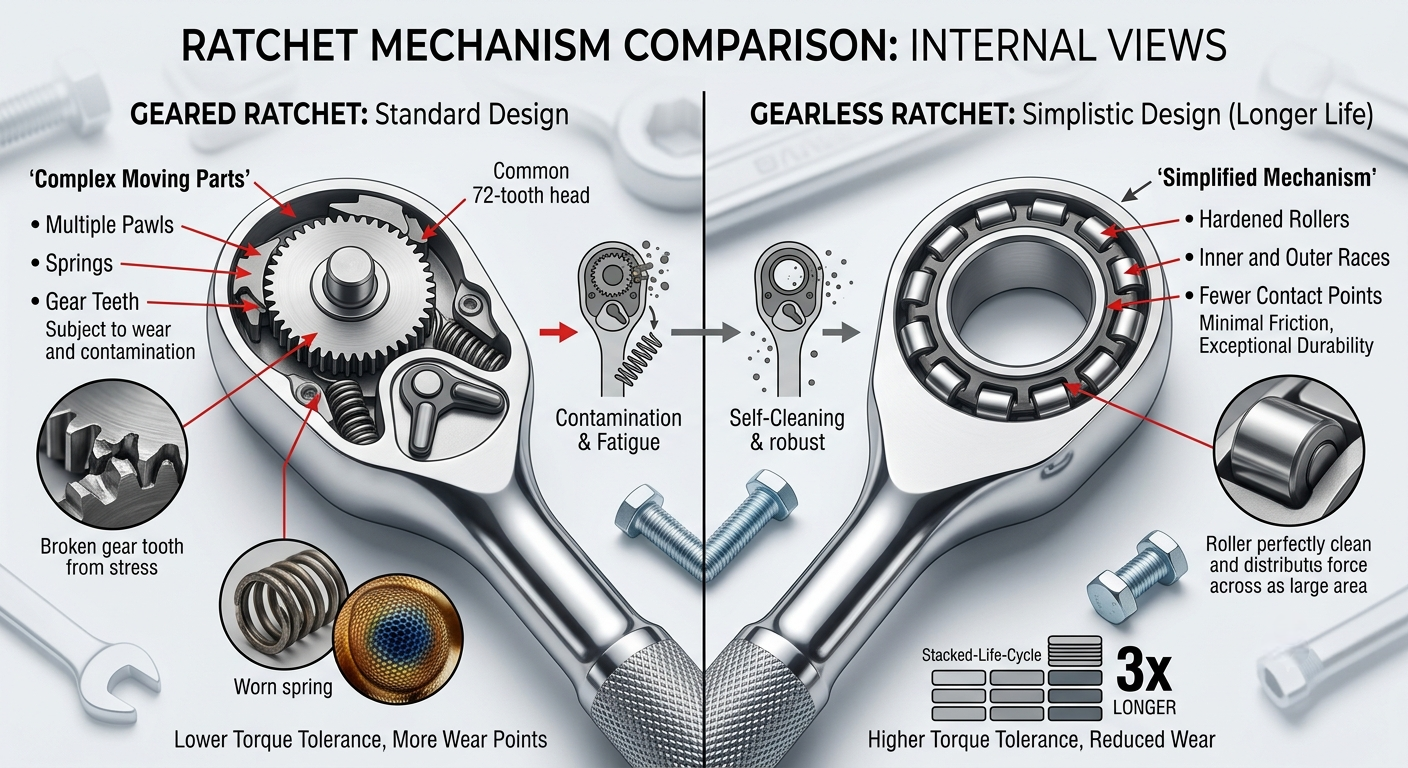
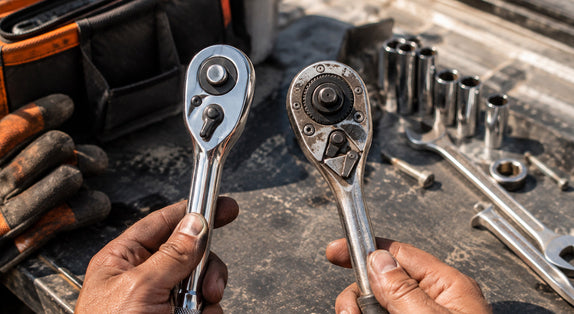
Open up a standard ratchet and you'll find a small gear wheel surrounded by a spring-loaded pawl — a tiny tooth that clicks into the gear to lock it in one direction. It's a design that's barely changed in decades, and it works fine, right up until those teeth start to round off. Gearless ratchets solve this problem in a completely different way, and once you understand the mechanical difference, it's obvious why the two tools age so differently under real workshop conditions.
How a Standard Geared Ratchet Actually Fails
Every time a geared ratchet clicks, a spring-loaded pawl slams into a gear tooth to catch the load. That's the entire mechanism: a tooth, catching another tooth, thousands of times a day. Under sustained torque, those contact points are where all the stress concentrates, and metal-on-metal impact in the same spot eventually wears the teeth down.
Once the teeth round off even slightly, the ratchet starts to slip. You feel it as that frustrating "give" under load — the handle moves half a click before it grips again. It's not a sign you bought a cheap tool; it's simply how a toothed gear mechanism behaves once repeated impact takes its toll.
What Makes Gearless Ratchets Different
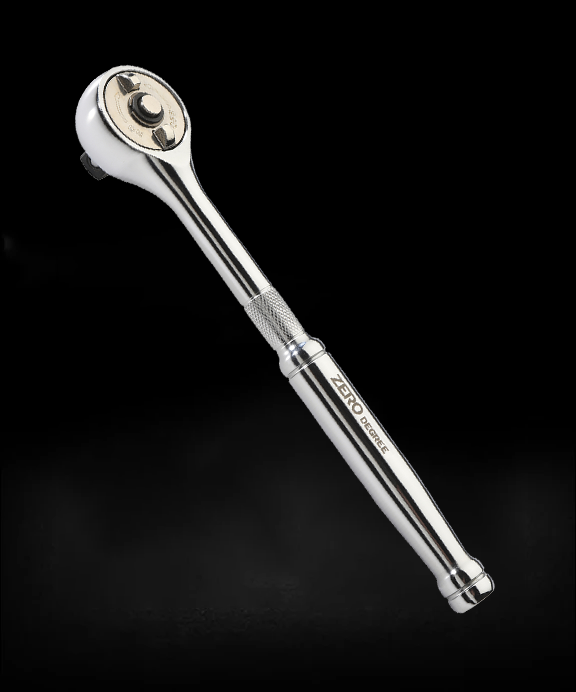
Gearless ratchets remove the tooth-and-pawl system entirely. In its place is a roller clutch: a hexagonal cam sits at the centre of the drive, surrounded by a set of cylindrical rollers housed inside a hardened steel race. When you turn the handle, the rollers wedge tight against the race and lock the drive instantly. Turn the other way, and they release just as fast.
There's no tooth to strip, no pawl to wear down, and no spring to fatigue. A magnetic direction selector — rather than a mechanical switch — lets you flip the drive direction with a light touch of the finger, which also removes another common failure point found in traditional switch levers.
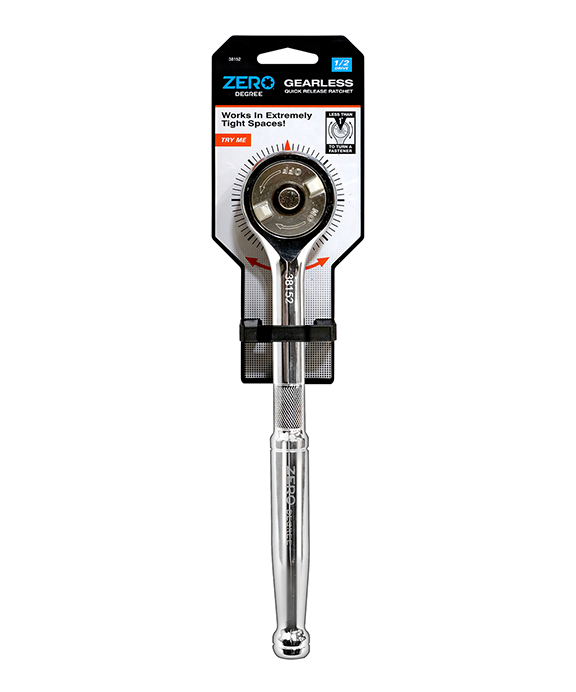
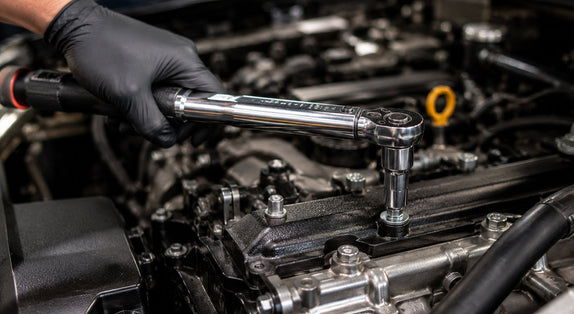
The practical side effect of this design is a dramatically tighter swing arc. Where a standard geared ratchet typically needs somewhere between 5° and 12° of swing to reset and grip the next tooth, gearless ratchets need less than 1°. In a cramped engine bay or behind a dashboard, that difference decides whether you can turn a bolt at all without pulling the socket off and starting again.
The Lab Numbers That Actually Matter
Marketing claims about durability are easy to make and hard to verify, so it's worth looking at what independent cycle testing actually shows. Ratchets built on this roller-clutch, gearless design have been laboratory tested under full load in both directions for 50,000 strokes, with no detectable wear or damage found afterward. Comparable high-end geared ratchets, tested under the same conditions, showed badly worn teeth and noticeable slippage after roughly 27,300 strokes.
That's not a small gap — it's close to double the working life before failure symptoms even begin to show. The same gearless design has also been measured at more than 164% of the ASME B107.110 failure-torque standard, the industry benchmark that ratchets and socket wrenches are tested against for strength and cycle life.
Why This Matters for Daily Use, Not Just Lab Conditions
Lab numbers are useful, but the real-world impact comes down to two things: fewer replacements and more predictable performance under load.
A geared ratchet gives you plenty of warning before it fails outright — you'll feel some slip, some play, a bit of "mushiness" in the click, well before it stops holding torque completely. A tool with a roller-clutch, gearless mechanism doesn't have that same wear curve, because there aren't teeth to gradually round off in the first place. The engagement point stays mechanically identical stroke after stroke, which is exactly why the lab testing shows no detectable wear rather than gradual, incremental wear.
For anyone using a ratchet daily — mechanics, fabricators, tradespeople working in engine bays and tight machinery — that consistency matters more than most spec sheets let on. A tool that behaves the same on stroke 40,000 as it did on stroke one isn't a gimmick; it's a fundamentally different wear mechanism.
The Trade-Off Worth Knowing
Gearless ratchets aren't without a compromise. The roller-clutch design generally needs a slightly larger head than a comparable pear-head geared ratchet, simply because the cam, rollers, and race all need room inside the housing. For most jobs this is a non-issue, but if you're working in an extremely confined space where head size matters more than swing arc, it's worth checking the dimensions against your specific application first.
Which One Should You Choose?
If you're occasionally reaching for a ratchet around the house, a standard geared set will likely serve you fine for years. But if you're using one daily under real load — automotive work, machinery servicing, tight-clearance fastening — the mechanical case for gearless ratchets is hard to argue with. Fewer contact points to wear, a swing arc small enough for spaces a geared ratchet simply can't turn in, and lab-verified cycle life that roughly doubles what a high-end geared tool manages before symptoms of failure appear.
It's a genuinely different mechanism, not just a marketing label — and that's exactly why it lasts longer.
Leave a comment